

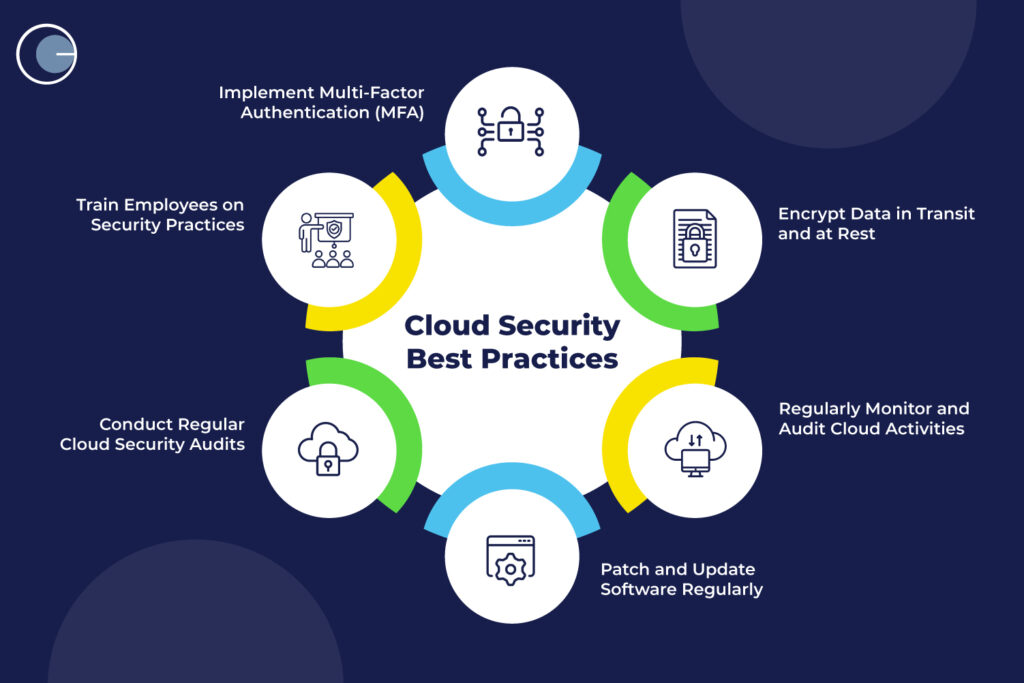
With an increasing number of organizations adopting cloud solutions, security emerges as one of the most important issues on the agenda of any cybersecurity professional today. Cloud technology has many benefits but it also introduces some new risks and potential problems that require careful consideration.
In order to help you deal with those challenges, this article will examine the most effective cloud security best practices that should be adopted by all companies and individuals using cloud technology.
-
Learn About the Shared Responsibility Model
Probably the first thing that needs to be discussed in this article is the concept of the shared responsibility model in cloud computing. In essence, it divides responsibilities between cloud service providers (CSPs) and their clients. While the former is responsible for securing the cloud infrastructure itself, the latter are expected to take care of securing their data and configuring access rights properly.
Specifically:
CSPs provide physical security of cloud services;
Users must protect themselves against any possible vulnerabilities related to access control, data encryption, and other factors.
Therefore, it is essential to understand how the shared responsibility model works.
-
Utilize Effective IAM Practices
Access control is a critical part of IAM, which plays a vital role in cloud security. Poor access controls lead to many cloud breaches.
It is essential to:
- Implement the principle of least privilege (PoLP)
- Enable multi-factor authentication (MFA)
- Conduct regular audits of access rights
- Limit account usage to roles only
Such measures ensure that each user has only required permissions to do his job safely without posing any threat to the organization.
-
Encrypt Data at Rest and in Transit
Another best practice is data encryption since encrypted data cannot be read by unauthorized persons even when intercepted during transmission.
It is recommended to:
- Apply AES-256 standard or other robust protocols
- Use HTTPS/TLS to encrypt data during transportation
- Safely manage encryption keys with KMS
Additionally, customers can manage encryption keys independently for better security of sensitive information.
-
Monitor and Audit Cloud Activities
Monitoring is vital for early detection and mitigation of cyber threats. Organizations should continuously monitor the activity to promptly detect anomalies.
- Good examples of monitoring techniques are:
- Enabling logging in all services and activities
- Applying SIEM tool solutions
- Setting up alert systems
- Running audits and compliance checks
- Continuous monitoring helps to respond quickly in case of an incident.
-
Secure APIs and Interfaces
The interface through which a service communicates or integrates other technologies is known as an API. A poorly secured API might serve as a gateway for attacks.
Recommended actions:
- Employ authentication and authorization tools
- Use API gateways
- Perform tests for vulnerabilities
- Minimize exposure by limiting accessibility
- APIs need to be secure in order to maintain the integrity of cloud applications.
-
Ensure Updates and Patching of Systems
One of the most common vulnerabilities that can lead to attacks involves outdated software. By applying updates regularly, we minimize the risk of being exploited.
- Recommended measures include:
- Automatic patch management
- Regular updates of operating systems and third-party applications
- Following vendor security bulletins
It may seem like too much effort, but keeping up with new releases provides excellent protection.
-
Backup Data and Prepare for Disaster Recovery
In case of cyberattacks, human errors, and even system failures, data loss is still a risk. A properly designed recovery plan allows minimizing risks.
Actions include:
- Data backups at regular intervals
- Keeping backups at geographically different locations
- Periodic testing of recovery plans
- Automation of backup procedures
- An effective plan allows minimizing risks and costs.
-
Implement Network Security Controls
Another security strategy involves implementing network security controls within the cloud environment. Correctly configuring these security controls can help avoid any attacks by unauthorized actors and lateral movement.
Effective measures include:
- Configuring firewalls and security groups
- Utilizing Virtual Private Clouds (VPCs)
- Implementing intrusion detection and prevention systems (IDPS)
- Segregating networks
It is important to implement multi-layer security strategies to protect against threats at different levels, such that if an attacker manages to bypass one security layer, other layers will still prevent them from accessing sensitive information.
-
Educate Employees About Security Best Practices
Most security breaches occur because of human error and lack of knowledge. Therefore, employees need to be educated about possible threats and how to mitigate them. This training should include educating employees on phishing emails, password management, secure data handling, and reporting suspicious activities.
-
Implement Zero Trust Security Models
In recent years, there have been significant improvements in cloud computing security models. Most of the existing models assume that users and computers on the same network are inherently trustworthy. However, zero trust does not make such assumptions; it considers all actors and computers as untrustworthy until proven otherwise.
-
Guarantee Compliance with Industry Standards
It is vital to follow industry standards not only because it may avoid any fines but also because it would be a means to strengthen cloud security.
Examples include:
- ISO/IEC 27001
- GDPR (for data protection purposes)
- SOC 2 compliance
It is useful to conduct a compliance assessment to detect deficiencies and strengthen security.
Conclusion
Cloud security is a never-ending process that implies a vigilant approach. With constantly developing cyber attacks, companies need to take a proactive stance on this matter.
With proper access control policies, data encryption, activity monitoring, and employee training, one could decrease the possibility of cyber threats substantially and build up a secure cloud environment.
The organizations that will pay sufficient attention to cloud security in 2026 and beyond will gain significant advantages over their competitors by ensuring the trust of customers and business continuity.
